Knowing how to order custom keychains starts with a usable purchase brief. Decide who will receive them, how the artwork should look, which attachment is needed and when the finished order must arrive. Those choices give a supplier something concrete to review before quoting.
For brand merchandise, event giveaways or a retail range, work through the material, artwork, sample and packing decisions in that order. This guide explains what to specify and what to approve, so the final order reflects your brand rather than a collection of assumptions.
Contents
- How to Order Custom Keychains with a Clear Purchase Brief
- Choose Materials for Custom Keychains for Business
- Prepare Artwork and Attachments Before Requesting a Quote
- Where to Get Custom Keychains Made
- How to Package Custom Die Cut Keychains for Retail Sale
- Frequently Asked Questions
- Confirm the Details Before Ordering
How to Order Custom Keychains with a Clear Purchase Brief
Start with the use, not a product photograph. A giveaway handed out at an event and a keychain sold as merchandise may need different packaging, artwork presentation and delivery priorities. State the audience, distribution method and destination before asking a supplier to recommend a construction.
Define the Use of Custom Keychains for Business
Write down the decision that matters most: a recognizable logo, a particular feel, a retail presentation or a fixed event date. For example, if an illustration needs to be visible from both sides, ask for a two-sided artwork proof. If the keychain must attach to a bag loop, specify that loop and check the proposed clasp opening.
Your first brief should include:
- Intended use and destination market.
- Artwork and the number of designs or color versions.
- Target finished size, material preference and attachment type.
- Estimated total quantity and quantity per design.
- Individual packaging and any assortment requirements.
- Required arrival date and delivery address or region.
Agree on the Approval Sequence
Use a simple sequence: submit the brief, review the proposed specification and quotation, approve the artwork, review a physical sample, then authorize production against the agreed version. Confirm inspection, packing and dispatch arrangements before the order is released. Ask which changes require a new quotation or another sample; changing the artwork after approval can also change the production plan.
Choose Materials for Custom Keychains for Business
Choose the material around the appearance and handling you want, then check that choice on a sample. A material name alone does not define the finished thickness, surface finish, printing method or connection strength. Ask the supplier to specify each of those details in the quotation.
Custom Acrylic Keychains for Printed Artwork
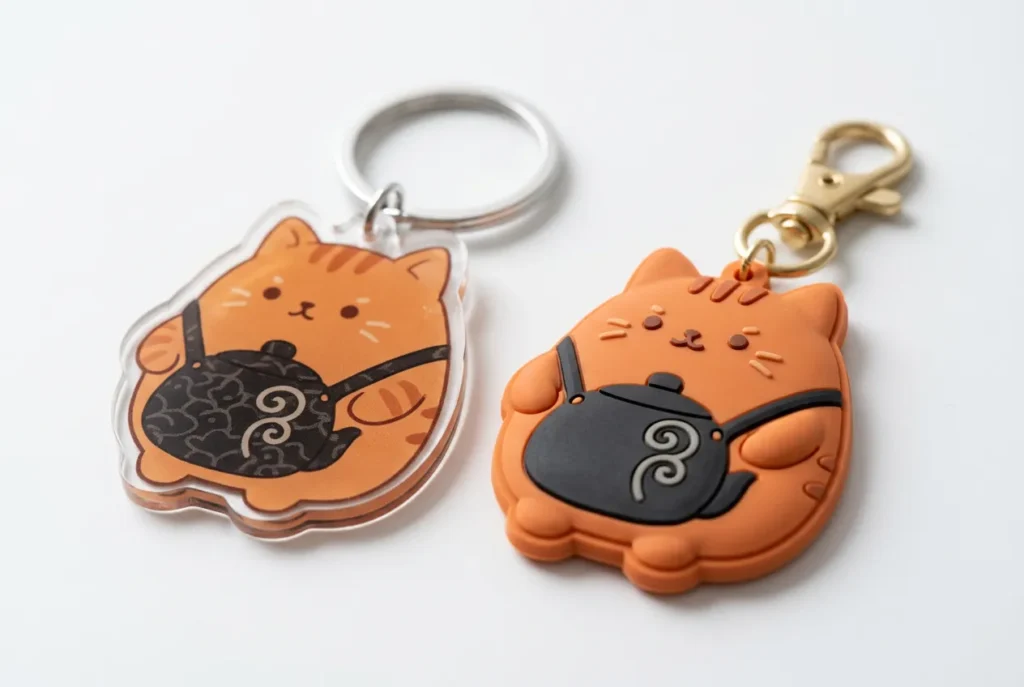
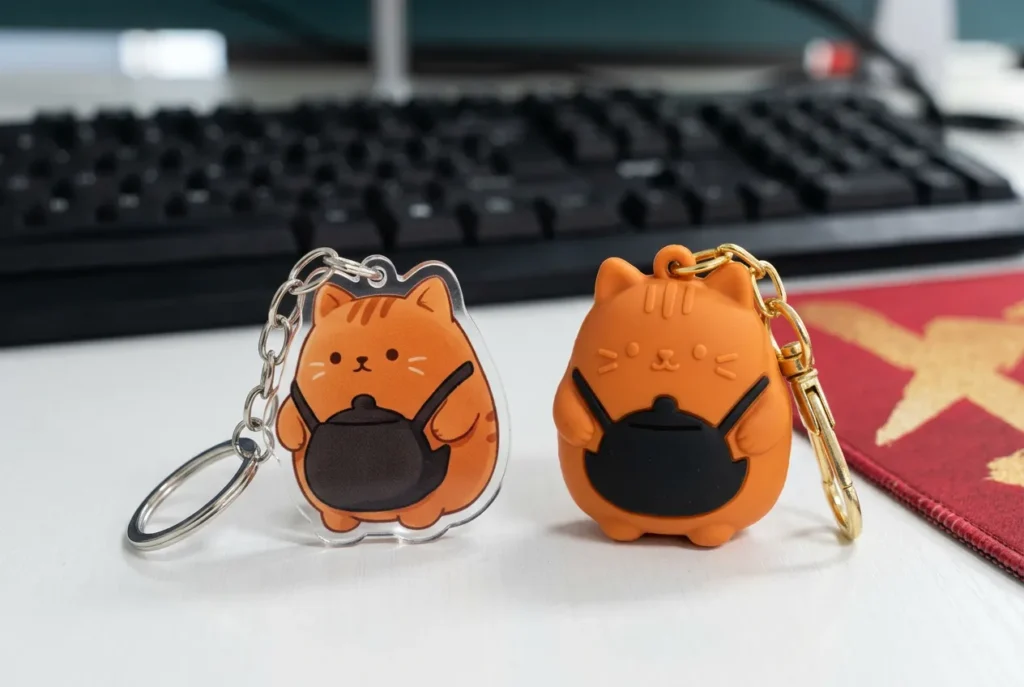
Consider custom acrylic keychains when the concept calls for a rigid, clear or flat printed format. Confirm whether the design is printed on one side or two, whether a white layer is needed behind the colors and how the back will look. Review the outline, edge finish and hole position together. Do not approve only a front-view mockup if the rear appearance matters to your brand.
Custom Rubber Keychains for Raised Details
For custom rubber keychains, define the intended softness and any raised or recessed details. Ask the supplier to identify the actual material formulation; the word “rubber” by itself is not a complete specification. Review fine lettering, narrow color areas and the attachment point on the sample. Request a revised drawing if the proposed process cannot reproduce a detail clearly.
Prepare Artwork and Attachments Before Requesting a Quote
Artwork for Custom Acrylic Keychains
Send the editable logo or illustration file when available, plus a clearly labeled preview. Keep the front, back, cut outline and hole location distinguishable. State the finished dimensions and color references. Ask which file formats the supplier accepts and whether any text must be converted to outlines before production.
Do not assume that an SVG file contains only editable paths. The W3C SVG specification explains that SVG can contain vector shapes, images and text. [1] Have the supplier check the actual file contents and confirm that the artwork is suitable for the proposed process. A file extension alone is not an approval.
Attachment Details for Custom Rubber Keychains
Specify the ring or clasp, its finish and the way it connects to the keychain body. Include connector length when it affects how the item hangs. Ask for a close-up of the attachment area and inspect the actual assembly on the sample. A convenient clasp opening is useful only if it fits the intended attachment point.
Apply the same checks to other materials. Record the approved hardware in the final specification so a later substitution requires review. If the product is intended for children, tell the supplier the age group and destination market at the start and request a product-specific compliance review before making any safety claim.
Where to Get Custom Keychains Made
Look for a supplier that can assess your design, explain the proposed construction and document approvals. Ask to see examples relevant to your material and attachment choice, then distinguish reference work from the sample made for your own order. Product photographs alone do not establish that a supplier can meet your specification.
You can review the product categories on the WEIMEI website and submit your keychain brief for project review. Ask the team to confirm the available material, decoration method and attachment for your design before treating any reference as an agreed product.
Compare Quotations on the Same Specification
Compare the same size, material, decoration, attachment, quantity split and packaging. Request a clear breakdown of unit price, setup or tooling where applicable, sample charges, packing and shipping. Confirm what is excluded and how design changes are charged. Separate sample approval time, production time and transit time when discussing the arrival date.
Approve a Physical Sample Against a Written Checklist
Check dimensions, front and back artwork, color, visible finish, edges, hole placement, attachment fit and packing. Record any changes with photographs and a version number. Approve the revised sample or agreed correction before production, and retain a record of the accepted specification. Ask how finished goods will be checked against that reference.
How to Package Custom Die Cut Keychains for Retail Sale
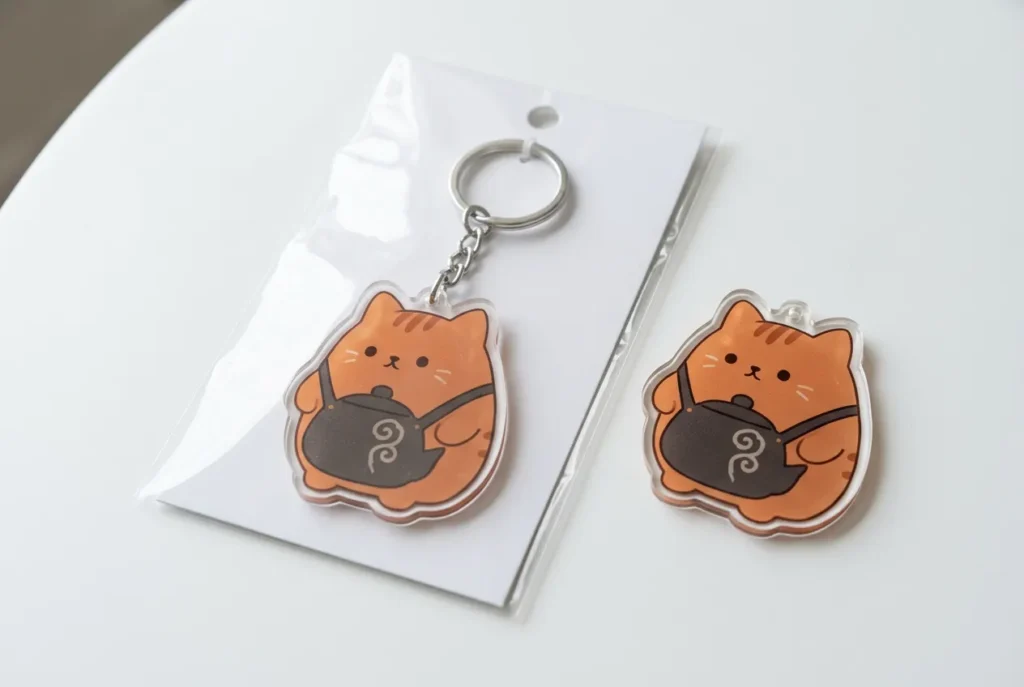
For a die cut design with an irregular outline, fit the package around the widest point, projecting details and attachment. Start with the way the item will be displayed: hanging on a card, placed in a sleeve or presented in a box. Test the packed sample rather than judging the empty package.
Protect the Printed Surface and Keep the Ring in Place
Ask the supplier to show how the keychain is held and whether loose metal hardware can rub against the decorated surface. Check that projecting parts are not forced against the edge of the sleeve or box. Confirm card dimensions, the display opening and any approved retail information before printing the packaging.
If several designs share one package, review the fit of each design and agree how styles will be identified and packed into cartons. A protective sleeve may be enough for one project; another may need a fitted insert. Confirm the actual requirement rather than applying the same retail package to every material or shape.
Frequently Asked Questions
Can I start before the artwork is final?
Yes. Send the concept, intended size, use and available reference images so the supplier can assess the direction. Confirm which design work is included and which files must be approved before sampling or production. An early discussion is not approval to manufacture.
What quantity and sample budget should I plan for?
Ask for a quotation based on your planned total and quantity per design. Minimum quantities, sample charges and any tooling costs need confirmation for the actual design and material. Do not assume that a quantity or free-sample offer from another product applies to yours.
How can I keep a launch date realistic?
Share the required arrival date, then ask for a schedule that separates artwork review, sampling, revisions, production and shipping. Include time for your own approvals. Confirm the plan again if the specification changes or a sample needs revision.
Confirm the Details Before Ordering
Before placing the order, make sure the brief, artwork, material, attachment, approved sample and packaging describe the same product. That consistency is the practical answer to how to order custom keychains for a brand. Send us your design, target size, estimated quantity, destination and required arrival date so we can discuss the next step.
Reference
[1] World Wide Web Consortium (W3C). SVG 2, Chapter 1: Introduction, section 1.1 About SVG.
Read the W3C SVG specification. Supports the distinction between vector shapes, images and text.